Peer-reviewed · Accepted for publication in ACM TRETS · 2026
DGNNFlow: A Streaming Dataflow Architecture for Real-Time Edge-based Dynamic GNN Inference in HL-LHC Trigger Systems
D. Maharaj, T. Pham, P. Meiring, K. Park, S. Durgut, C. Hao, M. Cremonesi
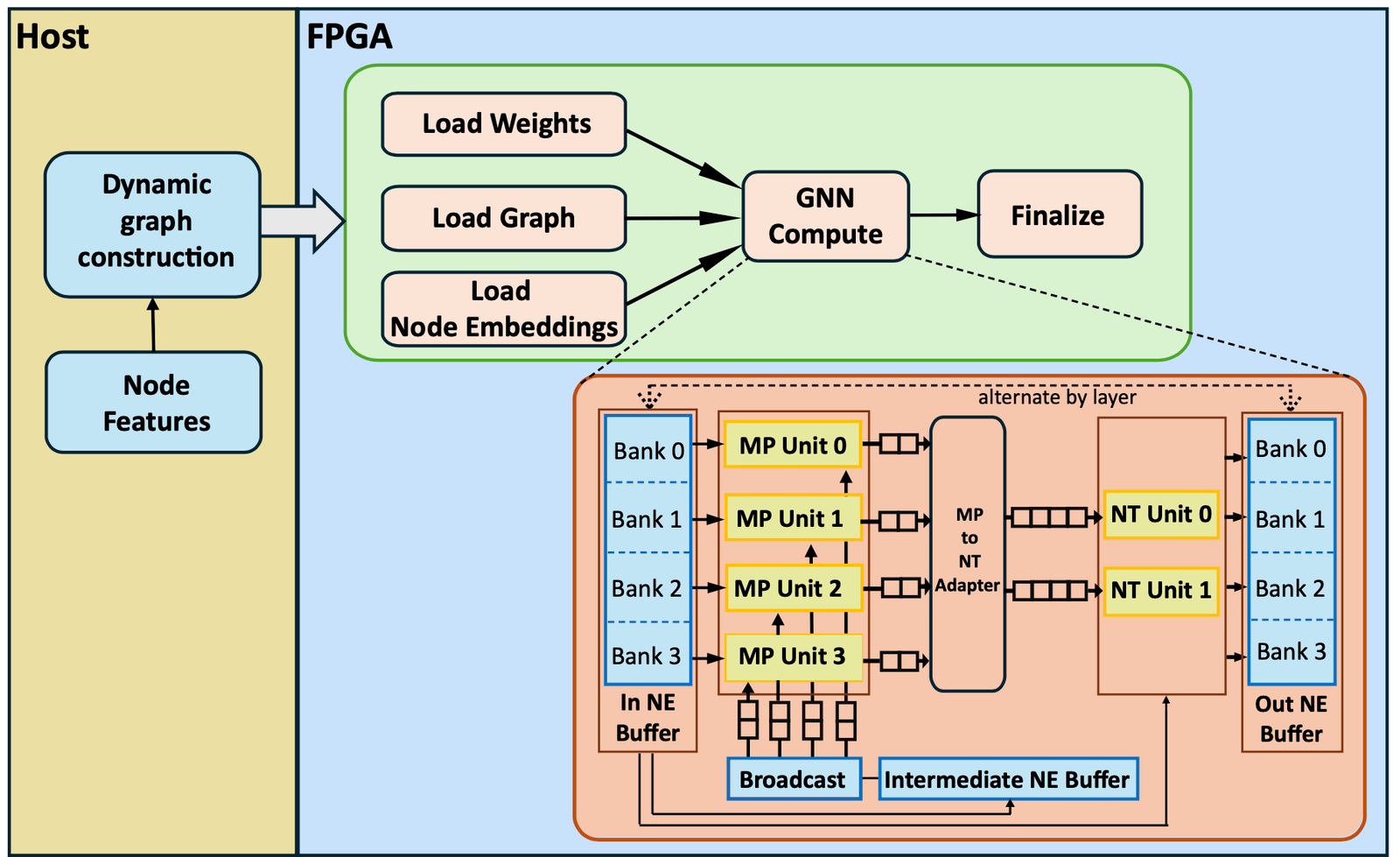
Dynamic GNN inference exhibits strong capability to model interactions over time, such as complex particle collision events in High Energy Physics (HEP) experiments at the High Luminosity Large Hadron Collider (HL-LHC). With a much larger scale of collision data captured in future HEP experiments, and limitations in both offline compute capacity and storage, revamped trigger systems require FPGAs to run ultra-low-latency machine-learning models with low power consumption for online filtering of useful events. Many state-of-the-art GNN accelerators rely on static graph structures, but this assumption breaks down in HL-LHC trigger systems and other edge-based dynamic GNN applications where edge embeddings can change in place based on neighbour node embeddings during runtime. We propose DGNNFlow, a novel streaming dataflow architecture for real-time edge-based dynamic GNN inference, with three key contributions: a hardware enhancement for edge-embedding dynamic computation; a Node Embedding Broadcast that alleviates data dependencies in the dynamic dataflow; and input dynamic graph construction for full support of graphs without pre-defined edge embeddings. Deployed on an AMD Alveo U50 FPGA at 200 MHz, DGNNFlow achieves 2.59×–4.36× speedup over an NVIDIA RTX A6000 GPU with 3.59×–3.70× less power, and 2.29×–3.54× speedup over an Intel Xeon Gold 6226R CPU.